

You don’t actually own your flat completely, and most homebuyers don’t realize this until it’s too late. Buying a home feels like a big achievement, but the truth about flat ownership in India is very different from what people believe.
What You Actually Own
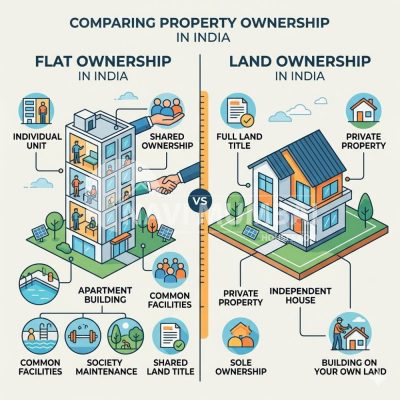
When you purchase a flat, you do own important parts.
For example, you get:
- The internal space of your home
- Walls, flooring, and ceiling
- Access to common areas
- A small share of the land
So yes, you are the legal owner.
However, ownership has limits.
What You Don’t Own in a Flat
At the same time, certain things are not fully yours.
For instance, you cannot independently control:
- The land itself
- The building structure
- Major structural changes
Therefore, ownership is shared among residents.
Why Ownership Is Shared
To understand this better, look at how flats are structured.
In most cases, properties are managed by:
- Housing societies
- Apartment associations
Because of this system:
- Land is owned collectively
- Decisions are taken together
- Rules apply equally
As a result, individual control becomes limited.
Why You Don’t Actually Own Your Flat Completely
Many people believe:
“If it’s in my name, I own everything.”
That sounds logical.
However, legally it’s not correct.
Registration gives ownership rights.
But it does not give full freedom.
For example, you cannot:
- Break structural walls
- Extend your balcony without approval
- Convert your flat into commercial use
- Ignore society rules
So clearly, ownership has boundaries.
A Real-Life Situation
Let’s say you want to upgrade your home.
You might plan to:
- Merge rooms
- Expand your space
- Start a small office
At first, it seems easy.
However, problems can arise.
In many situations:
- The society may reject the request
- Authorities may deny approval
- Legal issues can follow
Because of this, many buyers realize the truth late.
Ownership does not mean full control.
This is why you don’t actually own your flat completely.
The Most Important Factor: Land
Now here’s something most people miss.
 Land is the real asset in real estate.
Buildings lose value over time.
On the other hand, land usually increases in value.
When you buy a flat:
- Your land share is limited
- You don’t control it directly
Because of this, flat appreciation depends on demand.
Meanwhile, independent houses benefit more from land value.
What Happens After 20-30 Years
Every building has a lifespan.
Over time:
- Maintenance costs increase
- Structures start aging
- Value growth may slow
At this stage, redevelopment becomes important.
However, you cannot decide it alone.
Instead, it depends on:
- Society approval
- Builder interest
- Government permissions
Therefore, your future depends on multiple factors.
Is Buying a Flat Still Worth It?
Yes, it is.
Flats are still practical for many buyers.
They are a good option if you:
- Want an affordable home
- Prefer security and amenities
- Need convenience in city life
However, awareness is important.
You are buying shared ownership—not full control.
What Smart Buyers Always Check
Smart buyers go beyond price.
They also check:
- Land ownership type
- Society rules
- Builder reputation
- Redevelopment potential
- Future area growth
Because of this, they reduce risk.
Why This Truth Matters
Buying a home is emotional.
It gives you stability and security.
However, clarity makes it stronger.
When you understand ownership:
- You avoid mistakes
- You plan better
- You invest smarter

Final Conclusion
You don’t need to avoid flats.
Instead, you need to understand them properly.
Owning a flat means:
- You own your space
- You share control
And that is completely normal.
You can also verify property ownership rules on the official RERA website.
Final Thought
Don’t just buy a property.
Understand it first.
Because in real estate:
Smart buyers don’t just invest They invest with clarity
The post You Don’t Actually Own Your Flat – Truth Every Buyer Must Know appeared first on .